Useful Open Source Software: PSPP
update 6/11/2024: this is a post from a blog that I contributed to in 2011 called TechHacking, it shut down eventually but I was happy to be able to find some of my work through the internet archive.
PSPP is an open source version of the popular statistical software SPSS. It runs on a variety of operating systems including Linux, Windows, and Mac OSX. PSPP has many advanced functions and features that are useful to anyone who is either taking a course in statistics, using statistics in school, or even using statistics in their own research or work.
https://www.gnu.org/software/pspp/
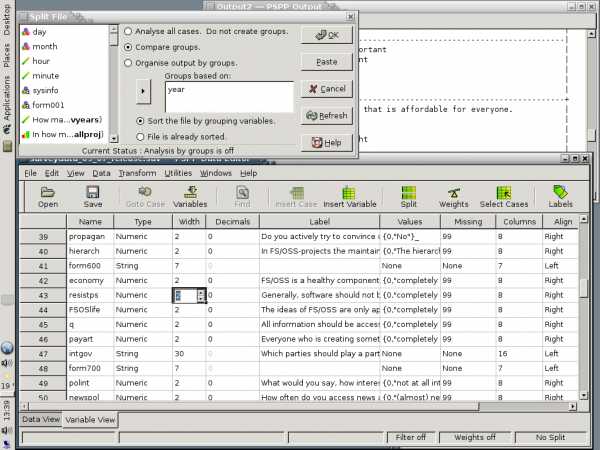
I came across this program when I was in my first statistics course last semester. The University recommended that we purchase a license for SPSS in order to assist us with all of our computerized statistical analysis. Although I initially was going to purchase it, I was really turned off by the fact that not only did you have to pay a ridiculous amount of money for an educational license, the license expired after a certain period of time and you were no longer able to use the program unless you renewed the license. That makes absolutely no sense to me, so being the open source geek that I am, I did a little bit of research and came across this wonderful piece of software that does everything that I needed to do for class, for free!
For those of you that do not know, you can do many basic statistical computations by simply using a spreadsheet of your choice. Most modern spreadsheet applications, including the open source LibreOffice, include statistical functions which make finding things like the Standard Deviation, Variance, and Mean a breeze. PSPP can do all of those things as well, but it can also do more advanced statistical computations that you are unable to do in a spreadsheet.
PSPP is a very useful piece of open source software, but it does have a slight learning curve. Especially if you have never had any experience with any type of statistical software. For users of SPSS you will find the interface very familiar, but for others there is some fantastic documentation that will have you solving problems with statistics in no time.
PSPP is available for download for:
- Windows
- Mac OSX
- GNU/Linux
- FreeBSD
- GNU/Hurd
The last time that I checked, most people who do statistics (students, researchers, professors) are not exactly made of money. So if you do any type of work with statistical analysis, from simple computations, to advanced multivariate analysis of variance, stop paying those ridiculous license fees and download your free copy of PSPP today!
Thank you for reading! Share your thoughts with me on bluesky, mastodon, or via email.
Check out some more stuff to read down below.
Most popular posts this month
- Microblog
- SQLite DB Migrations with PRAGMA user_version
- Setting up ANTLR4 on Windows
- Converting CSV to a SQLite Database
- How to Disable Wayland in Debian Testing
Recent Favorite Blog Posts
This is a collection of the last 8 posts that I bookmarked.
- The contagion of fear from The Observation Deck
- The revolt of the reader from The Observation Deck
- Deeper dive: Were Touch Bar’s problems software rather than hardware? from Unsung
- Joining Cursor from Fatih Arslan
- Pluralistic: Digital sewer socialism (08 Aug 2026) from Pluralistic: Daily links from Cory Doctorow
- Pluralistic: Enshittification and Reverse Centaurs go global (29 Jul 2026) from Pluralistic: Daily links from Cory Doctorow
- AI Mania Is Eviscerating Global Decision-Making from Ludicity
- The default person from https://popagandhi.com/
Articles from blogs I follow around the net
Issue 111 – Back the winners
A Trump crypto adviser’s firm took millions from Tether while he shaped stablecoin rules in their favor, a Senate probe targets Commerce Secretary Lutnick’s not-so-former firm, and crypto’s biggest super PAC plays it safe
via Citation Needed October 16, 2026Pluralistic: Load-bearing (16 Oct 2026)
Today's links Load-bearing: Digital sovereignty vs AI. Hey look at this: Delights to delectate. Object permanence: Anthrax penmanship; Stolen WEBGEEK license plate; Arizona Republic endorses Clinton, gets death threats; Against the great forces of history....
via Pluralistic: Daily links from Cory Doctorow October 16, 2026Abracadabra proposes winding down after string of hacks years ago left each $1 "stablecoin" token backed by $0.04 in reserves
Abracadabra, the defi project behind the Magic Internet Money (MIM) stablecoin, is shutting down. It blamed its string of hacks: $6.5 million theft in January 2024, $13 million in March 2025, and $1.8 million in October 2025, which altogether left about $2...
via Web3 is Going Just Great October 16, 2026Generated by openring